
Hitchhiking into Chicago through a snowstorm years ago, I found the interstate shut down and traffic backed up as far as Gary, Indiana, with not a snowplow in sight. The driver I was riding with was headed into Gary, so I took a detour, aiming to catch the South Shore commuter train around Lake Michigan and into the city.
When my driver dropped me off I hoisted my backpack, asked for directions, and started hiking toward the station. But it was slow going; Gary’s snowplows were overwhelmed, too. And every few steps, I couldn’t resist flinging my backpack down in the snow to help push another car out of a snowdrift.
The people heaving and shoving beside me were Black people; I was a long-haired hitchhiker, a stranger in their midst, with no car of my own. White folks were (and still are) a minority in Gary, home town of the Jackson Five; I was (and still am) White. But that day stands clear in my memory as one of those occasions when people become people again, members of the human species rather than this or that political, religious, cultural or ethnic subspecies. We were all pitching in to help whoever needed it next. And we were having a blast.
I hope you have experienced it too. In an emergency, people tend to revert to default: the genetic programming of our deep tribal past. We come together, neighbors, strangers, even erstwhile enemies, and pool our wits and resources to solve common problems, rescue those in trouble, share what we have to share and do what needs to be done. And even in crisis, an odd exhilaration takes hold as we strive together to surmount the odds.
The multiple interlocking crises of 2026 are a good bit more overwhelming than a midwestern snowstorm. But in a real sense, this is another of those moments when people rise to the occasion and revert to being people again.
As isolated individuals, peering out of the bunker of our cultural conditioning through our flat-screen periscopes, we see horrors, dangers, insoluble issues and insurmountable odds. Police brutality. Voter suppression. Wealth inequality. White supremacy. Nuclear waste. Nuclear weapons. Climate change. And looming over it all, the hostile takeover of our democracy by smooth-talking thugs.
Even on mainstream media, we occasionally catch a glimpse of people stepping forward, coming together in large or small numbers to take a stand. Whatever they’re protesting, from the bunker their cause looks hopeless. But what we don’t see from that limited vantage point is the exhilaration of meeting an emergency together, regardless of the outcome.
The people protesting ICE or working to turn out the vote have no guarantee of success; the odds may well be as insurmountable as they appear. But look at it another way. If no one takes action, failure is guaranteed. If we all join the culture of denial, take the bait of complacency – shopping, entertainment, sports, technology, drugs and alcohol – what kind of world will the children inherit?
From an individual point of view, one person taking action is as good as none. But each individual who stands up and takes action improves those odds. And if every single concerned person on the planet were to do so, the situation would look very different.
Hope Is Active!
If you’re looking for hope, you can’t get there by sitting in the comfort of your isolation, looking on. Hope lies in taking action – not on our own but together, sharing and cooperating, weaving our individual energies into a fabric of mutual support: a community of hope.
We are accustomed to seeing ourselves as individuals, with singular gifts and talents, proudly casting our single vote. But in the face of global emergency, when voting is no longer enough, another side of individuality emerges: contributing those very gifts and talents to the whole of which we are a part. For some, that is the neighborhood; for others, the watershed; for many, the entire human family or the Earth itself. Though never acknowledged in the media, these individual and collective efforts form a vast and diverse global movement sometimes called “The Great Turning.”
The late activist Joanna Macy worked for decades to help people overcome the hesitation, denial, and outright paralysis that prevents even concerned and informed people from taking action. Recognizing that guilt, grief, rage, depression, and addiction may be rooted in a deep, unconscious love for the ravaged Earth, she named her workshops “The Work That Reconnects.” In their electrifying book Active Hope, Macy and co-author Chris Johnstone identify three different but equally valuable ways to plug in to the Great Turning.
First, “holding actions” to hold back the tide of crisis: protests, boycotts, lawsuits, food banks, crisis hot lines, direct action of all kinds. Alongside these are efforts to build new structures and institutions that embody the world we want to see: co-ops, alternative schools, microlending, solar and wind farms, green building, organics and permaculture. Equally important are the visionaries seeding a fundamental shift in consciousness: from self-centered material gain to spiritual well-being, compassion for others, care for the planet and those who will inherit it. All of these are essential pieces of the work that needs to be done.
The first step in joining the community of hope is to turn within. Amid the cacophony of crises calling out to be addressed, which one awakens an answering call inside you? Or perhaps your calling lies in helping to create a new culture and economy to catch us when our tottering civilization finally falls. Or, perhaps, in awakening people to the inner transformations that lay the groundwork for outward change. Where do your particular gifts and passions inspire you to pitch in?
Next, look around for others who are stepping forward to meet you there. Usually at least one group or organization is answering the same call, working locally, regionally, nationally, even globally. Which level of involvement fits your level of commitment? Which group’s style and strategy suits your personal comfort zone?
Of course you can also help without joining a group: donate, sign petitions, “Like” and “Share,” write letters to editors and legislators, make a sign and show up for a march. But once you meet the people committed enough to work for change, you’ll discover a secret side benefit of activism: spending time with some of the best people around, not just at meetings and rallies but in casual socializing, conversation and friendship. The tactical advantage of community is not simply numbers, but its web of relationships. That sense of exhilaration and hope springs from a merging of purpose and connection.
What Makes You Come Alive?
Humans evolved in tribal groups, extended families, villages and urban neighborhoods; community has been the key to our survival since our hunting and gathering days. In many ways every issue we face, from local to global, stems from the loss of that ancient sense of belonging. I believe we will not survive our current challenges without reclaiming our genetic heritage of sharing and cooperation – becoming people again.
Remember the Buddha’s insight: nonattachment. The iceberg looms ahead, and no one can guarantee that we’ll succeed in turning the ship. But no one can be sure we won’t. Whether we succeed or fail, pooling our individual gifts to build community is inherently rewarding. Community itself is a victory over isolation, division, contention and competition. And as Margaret Mead never tires of reminding us, it’s the only thing that ever changed the world.
Countless activists, for example, have given their all to the cause of nuclear disarmament. Today we are closer to thermonuclear holocaust than at any point in the 80-year history of the Bomb. Yet for all we know, the planet might have long ago gone up in radioactive smoke had those activists not pursued their hopeless quest.
Listen to your heart, and your path will reveal itself a step at a time. The best contribution you can make is one that brings you joy, fulfillment, wholeness, alignment with your best self. As theologian and civil rights leader Howard Thurman once put it, “Don’t ask yourself what the world needs. Ask yourself what makes you come alive, and go do that, because what the world needs is people who have come alive.”
Yes, the odds look slim. But it’s becoming clear that if we cling to our isolated individual identities, the shipwreck that looms ahead grows more certain and our survival less sure. The hope of each individual lies in the community of hope.
My personal priorities cover all three of Macy and Johnstone’s pathways to hope. My past career in recycling and present anti-nuclear work are holding actions – pitifully inadequate in the face of the shameless profiteering of the nuclear and plastics industries, but supported by thousands of others doing similar work. Meanwhile, I am helping to build an alternative society by serving on the board of a Land Trust in an Atlanta neighborhood and by sharing the neo-tribal vision of the Rainbow Gatherings. And through my poetry, readings and workshops, I am working to cultivate “right relationship” with the natural world, re-learning the ways of respect and reciprocity practiced by our indigenous ancestors planetwide.
These are the priorities I’ve chosen as an activist. But I honor each person’s sense of the path that feeds their spirit. The community of hope is diverse and multi-faceted, with a place for each person’s unique contribution. I invite you to join us.
Note: As always, these are my personal opinions and do not represent any organization I’m involved with. If my words resonate for you, please share widely. Contains no AI ingredients! You can subscribe at StephenWing.com (and unsubscribe at any time). Read previous installments of “Wingtips” here.

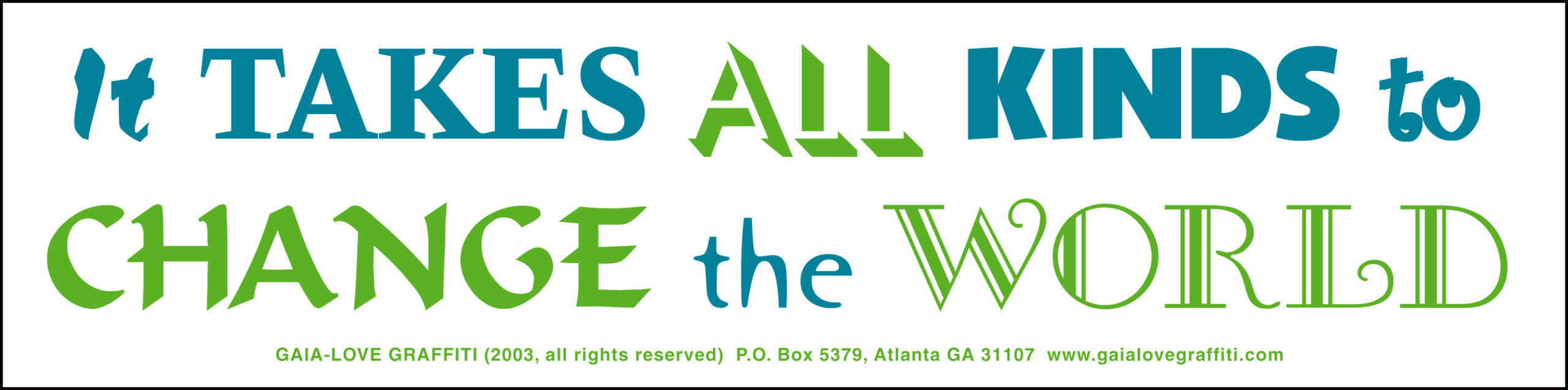
Wing’s original
stickers available at
GaiaLoveGraffiti.com




Ah Wing you woke up my tired heart and set it alight again. Thank you my friend and best Wing Man ever. Long may you preside 😊
I feel inspired, Wing! I’ll ramp-up my activities, knowing that I am on-the-right-track with my daily activism. Thank you for focusing on HOPE!