
Once upon a time there was a king so rich that he refused to eat from the same dish twice. His servants brought each new delicacy to the royal table on a freshly manufactured plate, and served each cup of mead in a brand-new chalice, straight from the box.
Out in his courtyard rose an immense heap of unwashed dishes thrown from the window of the royal dining room. It grew higher and higher until nothing else was visible from that window. The servants began carrying the king’s dishes outside and tossing them into the castle moat. The moat filled and overflowed, and before long the castle walls were encircled by an outer wall made entirely of unwashed dishes. The circular heap of dishes kept growing until it loomed above the castle walls, and nothing else was visible from any window in the whole castle. The king, however, had long ago stopped looking out the windows. He could always find something more exciting on TV.
The wall of dirty dishes kept growing until it towered above the turrets of the highest tower, above the highest banners and pennants and flags of the kingdom. Finally it grew so tall that one day it collapsed and killed the king.
When it fell, the avalanche of discarded dinnerware revealed a devastated landscape beyond the castle walls: strip mines, clearcut forests, drilling rigs, factories and refineries stretching to the horizon, all patriotically dedicated to providing plates, bowls, cups, utensils and napkins for the king’s table. But sadly, the king was dead.
Like any self-respecting king, this one had followed the custom of referring to himself in the plural, as the royal “We.” On formal occasions, he used his full title: “We the People.” His kingdom was the world’s oldest democracy. His plates, bowls, and cups were made of the finest paper, plastic, aluminum, and styrofoam. His napkins were of the whitest, purest paper. His knives, forks and spoons were artfully molded in high-quality virgin plastic. But oddly enough, as though under a sorceror’s enchantment, as soon as the king had finished his meal, each dish, cup, napkin and utensil was instantly transformed into greasy, stinking garbage.
Fortunately for the royal treasury, it proved unnecessary to build a pyramid in the royal tradition to properly honor His Majesty’s mummified remains. The heap of trash that had buried him made a pretty good substitute.
Life in the Royal Bubble
When my company’s Recycling Coordinator moved to California, I was offered the job – on one condition. I would have to motivate my co-workers to recycle without making them feel guilty. I was new to the company then, but apparently my predecessor had overworked that particular angle.
I accepted the challenge. But I soon found that it’s not easy to persuade people to give up a lifelong habit such as disposing of disposable things in the trash. My pledge to resist employing the persuasive power of guilt began to feel like an itch I couldn’t reach.
Although technically “We the People” are indeed the rulers of the Kingdom of Democracy, most of us do not feel we live like kings. We have seen the gap between regular Americans and the ultra-wealthy steadily widening for generations, with no end in sight. Still, the lifestyle of the average American would astonish the average medieval king. Even compared to the wealthy founders of our republic – and the majority of regular folks around the world today – we live a life of unimaginable luxury. We can afford to throw away a styrofoam plate, a plastic cup, a set of disposable utensils and a paper napkin after every meal, and some of us actually do.
The bad news is that this royal lifestyle of ours is overwhelming the life-support systems of the only planet known to support life. Disposable dinnerware is only one example. Our single-use ketchup packages, drinking straws, lighters, batteries, sterile gloves, and myriad other disposables assault the natural world at three different points.
First, they are all made of raw materials “extracted” – the polite term for relentless mining, drilling, and clear-cutting – from the Earth. “In the last fifty years,” environmentalist David Brower warned back in 1998, “the U.S., alone, has used up more resources than all the rest of the world in all previous history.”
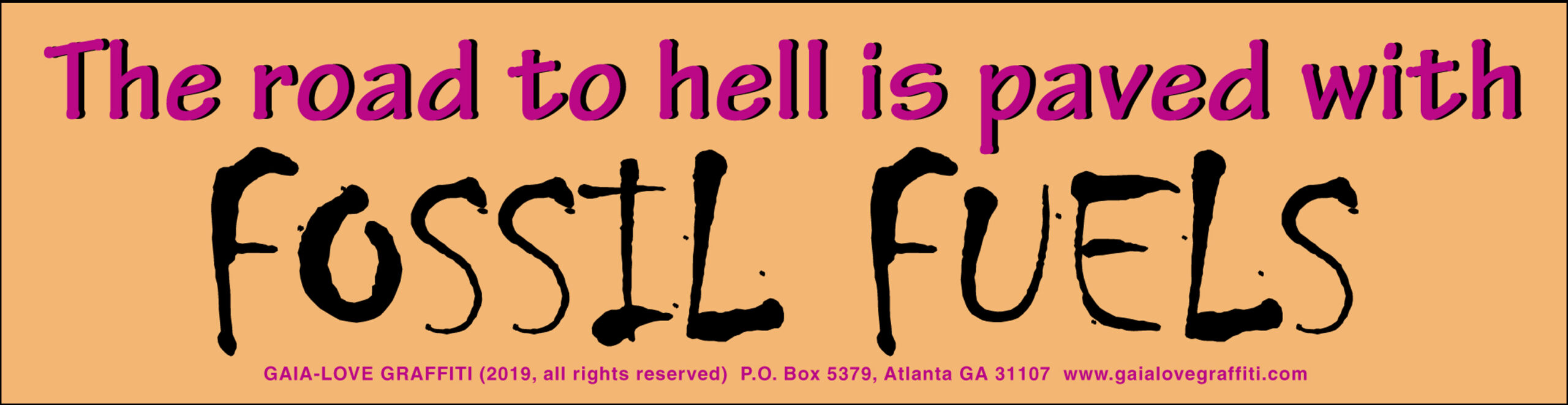
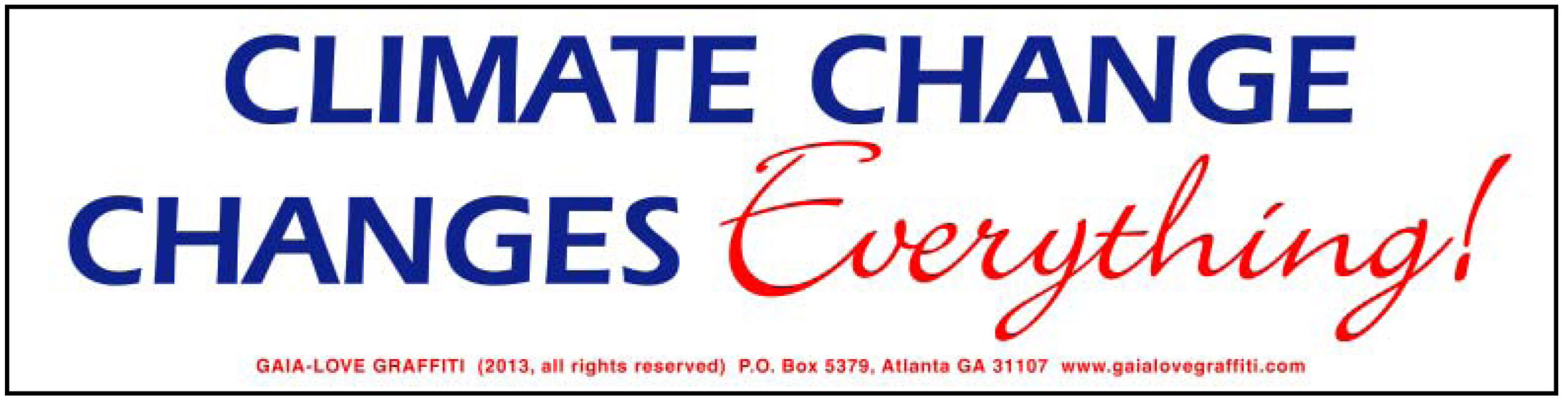
Second, shipping these materials from far-flung locations to refineries, smelters and factories, and then processing them into disposable products, burns monstrous amounts of fossil fuels. As everyone knows except Donald Trump, this is rapidly destabilizing the benevolent climate and weather-patterns that have sustained human civilization from the start.
Third, when dumped into a landfill, our disposables break down into chemical byproducts that leach into groundwater; shoveled into an incinerator, they spew those same chemicals into the air. Both landfills and incinerators also release methane, a greenhouse gas far more potent than carbon dioxide in the short term.
If everyone in the world lived as we do, by some calculations it would take five planet Earths to supply all the raw materials we would need and absorb all the toxic waste and greenhouse gases we would generate. Since we only have one planet, we are rapidly using up the resources our children will need to live decent lives.
And of course, everyone in the world does want to live this way. Hollywood movies, one of our most popular exports, advertise all of the glamor of the American lifestyle but few of its toxic consequences. In China and other boom-town economies, a rapidly growing middle class is emulating and even exceeding our excesses.
“Historically,” writes Lester Brown, founder of the Worldwatch Institute, “we lived off the interest generated by the Earth’s natural capital assets, but we are now consuming those assets. We have built an environmental ‘bubble’ economy, one in which economic output is artificially inflated by overconsumption of the Earth’s natural assets. The challenge today is to deflate the bubble before it bursts.”
From Acting Consciously to Being Conscious
The chorus of voices echoing such warnings has grown exponentially since way back in 1991, when I accepted the position of Recycling Coordinator and the challenge that came with it. I’m sure I did occasionally succumb to the itch to guilt-trip my fellow employees. But for three decades, as I made my weekly rounds of trash and recycling bins, I had a front-row seat as ecological awareness took root and grew, and recycling slowly became the accepted norm at one small company.
Meanwhile, my own awareness was also growing. As I did my best to coax and provoke and persuade my co-workers to recycle, I began to see that recycling is only the first step toward a “sustainable” society – one that doesn’t steal from future generations to pay its current bills – and a baby step at that. As I sorted and bagged and hauled off load after load of recyclables, in my personal relationship with waste I was already taking the next step.
All recyclers make the same journey, I imagine. Once we accept the necessity of minimizing our personal waste-stream by recycling, we are eager to recycle everything we possibly can. Little by little the aspiration becomes a creed, an obsession, a lifestyle. That naturally leads to the next step: we begin to resist buying things we can’t recycle, including the packaging they come in.
But beyond that is another step: trying to buy nothing we have to recycle. Recycling, after all, addresses only that third point of impact, the environmental cost of disposal. Recyclable packaging, such as that innocent-looking soda can, is still produced from raw materials ruthlessly extracted, shipped around the globe, and processed in smelters and factories. Whether or not we recycle the can, purchasing the soda sends a signal to the marketplace of supply-and-demand to produce not only more soda, but more cans.
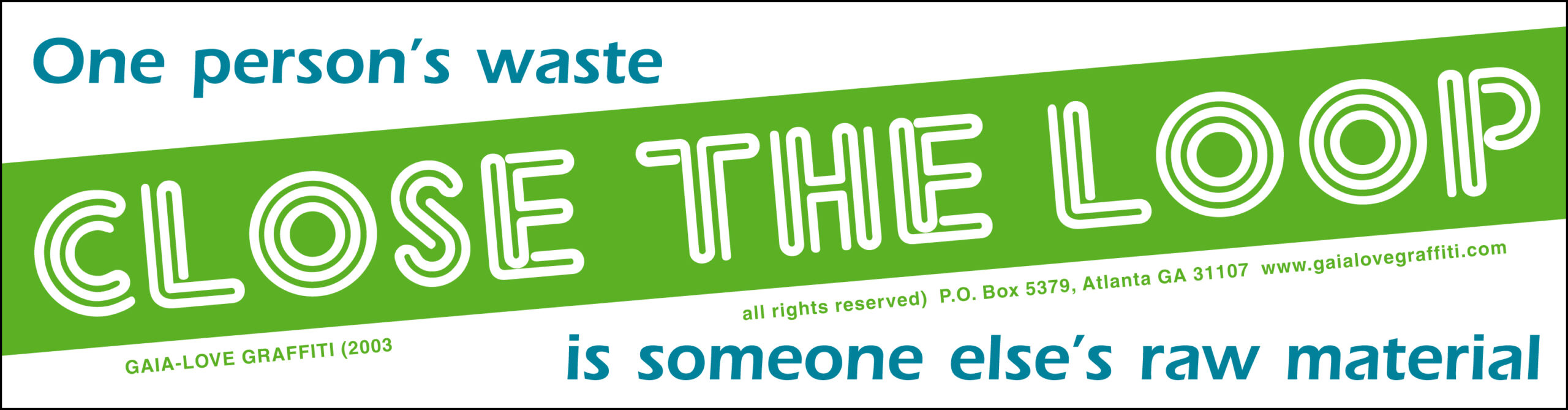
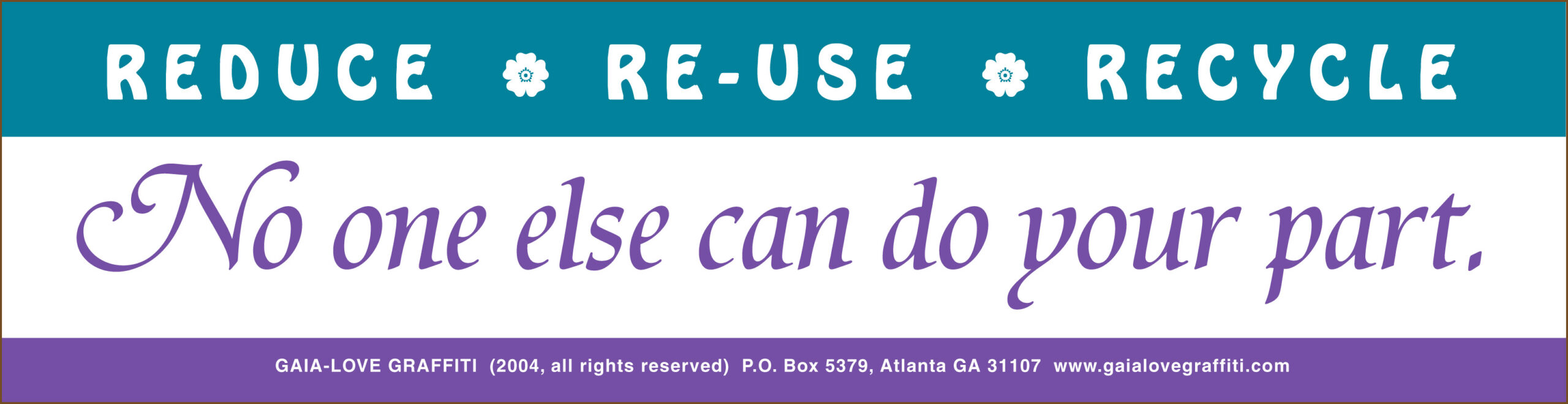
So beyond recycling is the step of re-use. And beyond that is the step of reducing unnecessary purchases. And once we get there, we find there is another step beyond that. Each is just one step in a lifelong journey of expanding awareness and responsibility.
At first, tossing a soda can into the recycling instead of the trash is a decision – we are acting consciously, based on our understanding of resource extraction and the toxicity of garbage. But before long it becomes an automatic reflex – being conscious. We no longer have to think about it.
This shift in attitude is far more important than the act of recycling itself. Though only a first step toward genuinely reducing our impact, it represents a totally new paradigm. We have moved beyond ignorance, beyond indifference, beyond guilt, even beyond responsibility into a whole new identity. We have graduated from acting solely as an individual to acting as a conscious part of a greater Whole. We act on behalf of the entire planet and all of its inhabitants because we recognize that their needs and ours are the same – because they are us.
This shift does not require sacrificing one iota of our unique and precious individuality. On the contrary: only a free-willed individual can take such a step, and only a learning, growing individual can reach the level of consciousness that prompts it. The whole process can only take place within an individual. It cannot be mandated by even the most oppressive government or the most restrictive religion. It’s called “conscious evolution,” and it is accelerating around the globe as people free themselves from mindless materialism and self-centered consumerism.
Note: As always, these are my personal opinions and do not represent any organization I’m involved in. If my words resonate for you, please share widely. You can subscribe at StephenWing.com (and unsubscribe at any time). Read previous installments of “Wingtips” here. Contains no AI ingredients!

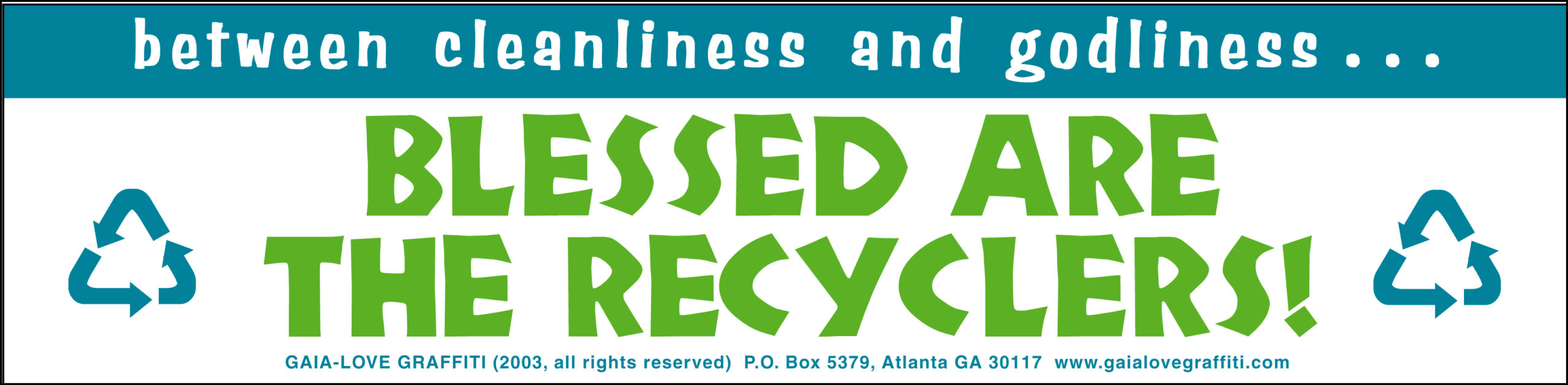
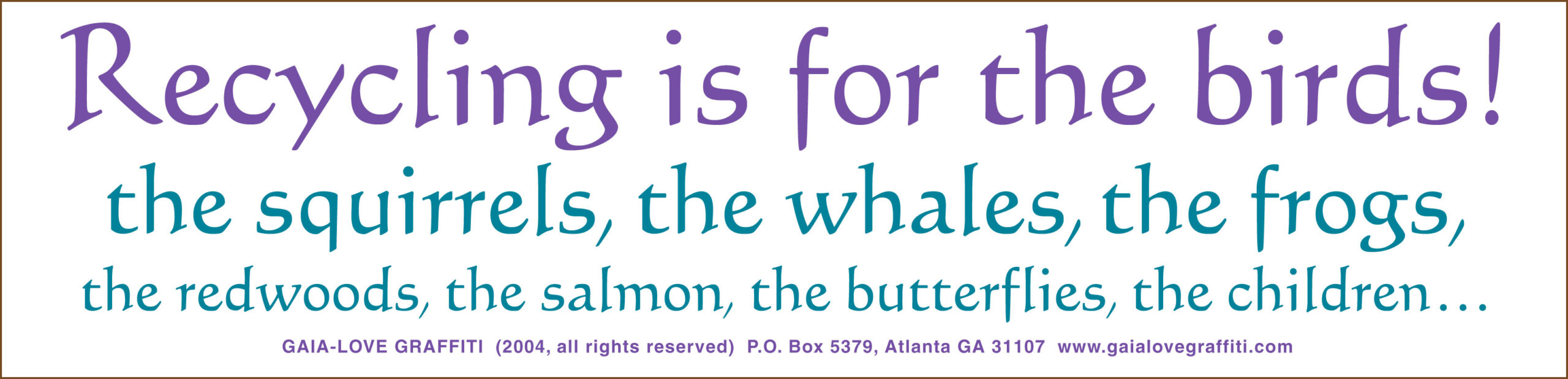
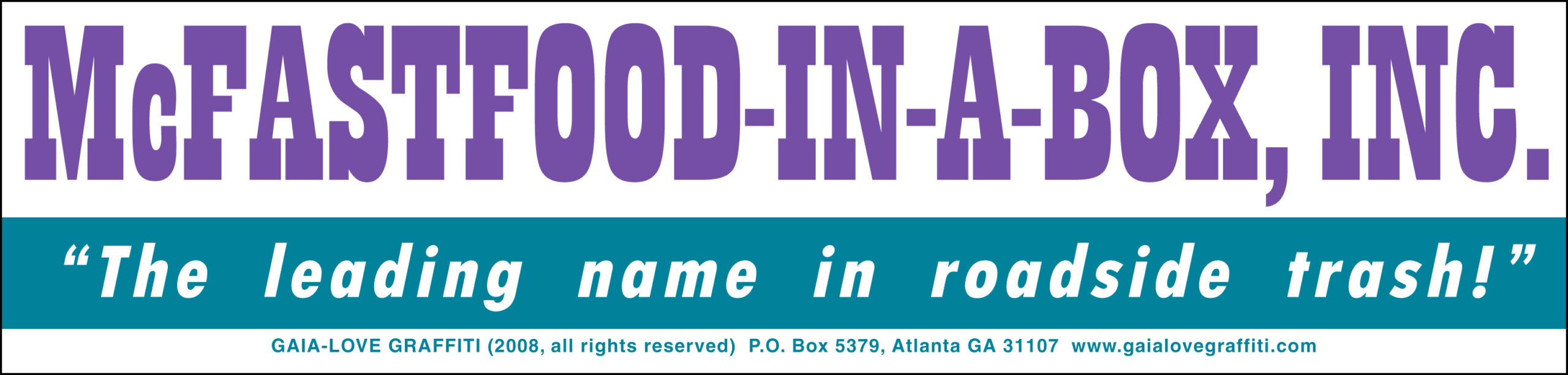
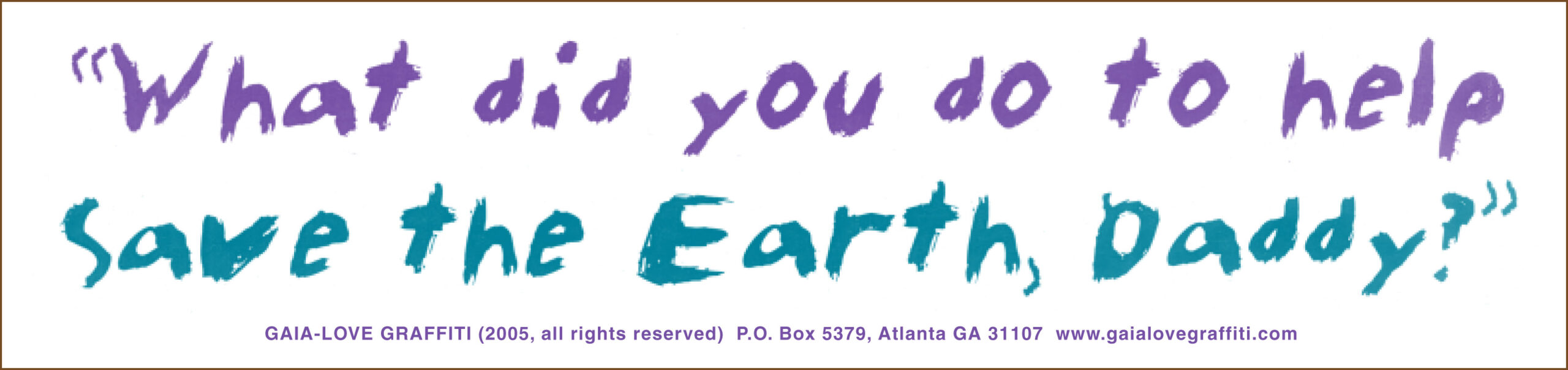
Wing’s original
stickers available at
GaiaLoveGraffiti.com
Right on, Wing! Right on!!!!
well done, Stephen. I’m sharing