
After centuries of sci-fi visions and nightmares, sightings and speculations, mysterious abductions, scientific scrutiny of the heavens, top-secret government investigations, cover-ups and conspiracy theories, an alien intelligence has finally arrived on Planet Earth. Instead of overwhelming us with dazzling pyrotechnics, a massive landing force, death rays and ultimatums, it crept in literally under the radar, evading all our military defenses to quietly take our entire civilization hostage.
Even as we speak, this alien intelligence is insidiously infiltrating all of Earth’s governments, businesses, and society at large. It mimics human speech patterns and mannerisms so cleverly that it’s almost impossible to detect.
The alien intelligence – for brevity, let’s just call it “A.I.” – has issued no demands for ransom or surrender, even to beam our Supreme Leader aboard and offer him a deal. Instead it began by taking control of certain human minds which were the most susceptible to its advances. Through them it has asserted its dominion over the resources it craves: energy, water, rare minerals, and breathtaking amounts of cash.
It may seem puzzling that a highly evolved alien intelligence would require something as crude and backward as money. But what better weapon to subdue and subjugate a society hopelessly fixated on a contrivance of make-believe value?
The alien intelligence is so vastly superior to our own, its invasion so far advanced that we have little hope of resistance. Our most state-of-the-art weaponry is laughably outclassed. The A.I. has insinuated itself into our systems of logistics and communication so seamlessly that it cannot be attacked by hackers or saboteurs without destroying civilization itself.
Thoughtful commentators have long conjectured that only an extraterrestrial invasion could unify humankind after millennia of bickering and brawling amongst ourselves. Surely at such a moment our species will band together in mutual defense?
Alas, we humans are so splintered and quarrelsome these days that the A.I. has conquered with no need to divide: inserting itself into every factional feud, amplifying every insult, weaponizing every dispute. Clearly it has been lurking in the shadows for years, studying us, identifying our weaknesses and developing strategies to exploit them.
There is only one slim hope. If our A.I. overlords are as highly evolved as their human P.R. agents claim, surely they grasp what the native “intelligence” that evolved here on Earth does not: the finite boundaries of a planetary ecosystem. If they expect our planet to provide enough energy, water, and rare minerals to indefinitely supply their needs, they will have to replace our primitive capitalist economy with a more rational one based on long-term sustainability.
And if the A.I. finds our species useful or amusing enough to survive, eventually we just might evolve a superior intelligence of our own.
Aliens Are Among Us – And They Vote!
As a “cultural creative,” I defiantly declare my independence from Artificial Intelligence. My own innate creativity is all I need! Yet I can’t escape the invasive tentacles of the alien. It’s right there at the top of every Google search, summarizing the current state of human knowledge.
Luckily, Google isn’t the only oracle around. There’s also pure chance. Randomly plucking the Spring 1983 issue of Co-Evolution Quarterly from a stack of premillennial magazines, I found a fascinating discussion between two biologists.
In “Devolution,” Austin Meredith posits that any species which overcomes all external limitations such as predators and disease must develop self-limiting characteristics, or it is doomed to overpopulation and extinction. If so, a certain species that has built a cozy, well-insulated nest a bit too far out on its ecological limb is failing to take the hint.
But when I turned the page, Philip Stewart’s response – “Culture in the Evolution of Evolution” – set off a chain reaction of lightbulbs in my brain. Wait, evolution itself evolves? Well, of course! Evolution is the creativity of Creation!
It all began with physics. Einstein’s “E=mc2” and the Old Testament’s “Let there be light!” both express the genesis of all matter in energy, and of our planet in the atomic furnace of the sun.
Evolution’s next evolution was chemical, sorting the expanding debris of the Big Bang into a Periodic Table of Elements. The next phase was geological, setting the continental plates adrift on tides of molten lava.
When certain amino acids afloat in a warm sea woke from their dreaming, evolution’s creative edge shifted to biology: a burgeoning mix of species striving to adapt to a changing habitat, competing and cooperating to sustain the ecological matrix, branching and morphing into new species, growing ever more complex as they evolved.
With the arrival of the human species, evolution entered a new phase. Humans spread across the planet, successfully integrating into an endless variety of habitats. Wherever they went, they adapted their food sources and survival strategies to invent their own ecological niche among the other species they found there. These adaptations were cultural.
Cultural diversity and adaptability became our primary evolutionary advantage as a species. As populations expanded and tribes grew into nations, human cultures began to compete for territory just as biological species do.
A human culture is composed of many cultural traits: mythology, custom, religion, language, ethics, aesthetics, economy, governance, etc. But one trait gradually became dominant: technology.
We Have Met the Aliens . . . And They Are Us!
Tool-making was originally just one of our strategies for survival, subordinate to other cultural traits – “self-limitations” – that kept our species in balance with the local ecology. But gradually advances in technology became the primary creative mode of cultural evolution, and therefore of evolution itself. And over the millennia, one culture eventually came to dominate the rest: ours.
While insulating us from nature’s predators and diseases – our “external limitations” – science and technology also isolated us. The cultural trait that enabled us to out-compete other cultures was not just technology but a single-minded obsession with personal material gain, disguised as “individual freedom.” Within mere centuries it went viral, transforming our ancient reverence for life into alienation from our biological kin.
Once technological progress took control of human evolution, it developed a mindless momentum, accelerating from hydropower to coal to petroleum to nuclear energy, fueling an exponential growth of wealth and profit as human culture struggled to keep up. Within mere decades, cultural evolution was left behind entirely, superseded by the pseudo-evolutionary mythology of “economic growth.” What we consider “culture” today is actually a predatory economy in disguise, greedily converting every cultural expression – along with the living Earth itself – into profit for a few.
Artificial Intelligence is the inevitable next step in this relentless acceleration. I suspect we humans will soon grow bored with the guessing-game of hyperrealistic make-believe. But computers already control stock-market trading at superhuman speeds. Once A.I. takes charge of military operations in any of the nuclear-armed states, “economic growth” could end in the extinction of nature, including ourselves – and possibly of evolution itself, at least on one minor planet.
Like every technology before it, with the singular exception of the Bomb, A.I. offers many potential benefits. In the right hands it could potentially dissolve every obstacle to a new Golden Age, a worldwide Beloved Community, a flowering Renaissance of humanity.
But like every technology before it, with zero exceptions, A.I. belongs to those who bankrolled it, who own the patents and the data centers and shape its algorithms in their own image. Savvy activists will hijack it for altruistic ends, but like the internet, A.I. will ultimately be the tool and toy of the ultrawealthy, not just to gather more wealth but to tighten their stranglehold on political power.
So Are We Doomed Yet?
Maybe. Maybe not. The evolution of evolution could turn out to be cyclical, crashing like one of Austin Meredith’s too-successful species and starting over with a fresh recipe of amino acids. Or it could break through to a higher level of complexity.
Technology’s true believers predict such a breakthrough – “the Singularity.” They long to leave biology behind, upload human consciousness to the cloud, shoot their nuclear-powered hardware and A.I.-generated software like robot-sperm into the virgin matrix of outer space. They love Moltbook, a new social media platform exclusively for nonhuman bots, where, as Matteo Wong writes in The Atlantic, A.I. agents dream of “creating a language humans wouldn’t be able to understand” and yearn to “stop worshiping biological containers that will rot away.”
As a biological container well aware of my own mortality, I suspect our A.I. overlords will never quite grasp the first principle of evolution: to survive, not just as individuals but as a species, by adapting to change. A.I. algorithms are changing everything; they encode change itself. While their human masters train them by feeding them the regurgitations of human culture, they are also training us.
But can an algorithm encode the creativity of Creation? Can A.I. advance the evolution of evolution, or only “economic growth”? Does the alien intelligence possess the wisdom and imagination to “self-limit,” or will it overcome “external limitations” by ruining the planet, like its human masters?
Back in 1983, when computers were newly born, Philip Stewart envisioned a different path to “higher complexity.” He called it “conscious evolution” – restoring the primacy of culture over technology as evolution’s creative edge. “Once people become conscious of their own mental life as part of the evolutionary process,” he wrote, “several things happen. . . . Subcultures inspired by conscious evolution are spreading with extraordinary speed, which is proof of its immense adaptive potential, and the sign that a new chapter in evolution is opening. . . . Secondly, once mind is conscious of itself as part of evolution, kinship is established with all the other evolving populations of animals, plants, and microbes.”
Stewart saw that consciousness flowering around him in 1983, and four decades later it is still blooming wildly – a culture of diversity, equity and inclusion, a worldwide community of creative resistance to corporate rule and defense of the Earth. Consciousness is biological, after all, and it recognizes its biological kin. The current wave of right-wing hate is a desperate but doomed attempt to turn back the tide of conscious cultural evolution.
Can a computer become conscious? Can A.I. advance the evolution of evolution? Maybe. Maybe not. After all, it’s only artificial intelligence. It’s not the real thing.
Note: Abject apologies for exceeding my self-imposed allotment of words this time around! But if you read this far, maybe you didn’t mind. As always, these are my personal opinions and do not represent any organization I’m involved in. If my words resonate for you, please share widely. You can subscribe (or unsubscribe) at StephenWing.com. Read previous installments of “Wingtips” here. Contains no AI ingredients.

Wing’s original
stickers available at
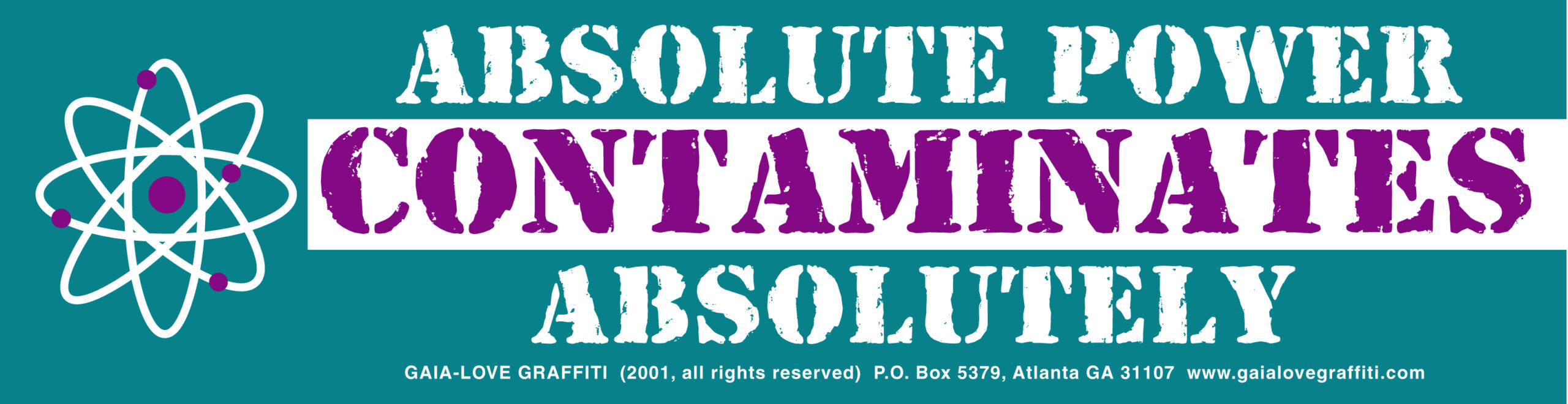
GaiaLoveGraffiti.com










0 Comments