I live in a democracy, where time and time again, ordinary citizens have taken to the streets in vast numbers to demand change, pushing democracy slowly but steadily forward, making it more fair, more just, more democratic.
But I also live in a nation openly ruled by a wealthy elite, the infamous “One Percent,” who over the past half-century have spent millions to roll back the gains of the great people’s movements of the 20th century and exponentially increase their own wealth, power, and control.
During the same period, my government has expanded its military supremacy around the world through covert wars, right-wing coups, proxy dictators, bombers, troops and drones— benefiting no one except the giant multinational corporations which are no more than a façade for the same wealthy One Percent.
And since the turn of the 21st century, Republican and Democratic administrations alike have abandoned all pretense of nuclear “deterrence” to aggressively surround both Russia and China with land and sea-based first-strike forces. Vladimir Putin’s brutal invasion of Ukraine, backed by the shadowy threat of nuclear Armageddon, is the predictable result.
As always, it is the poor at home and abroad who bear the brunt of my government’s crimes against humanity, and ordinary taxpayers like me who pay for them. As a citizen, I recognize my responsibility to join others in resisting these crimes committed in my name, whenever and however I can. And as a poet of conscience, I find them insistently surfacing in my writing as well.
For me, poetry is a way of responding to what moves me and of grappling with what really matters to me, which are usually one and the same. Though I personally have escaped injury and indignity at the hands of the powerful, very little moves me as deeply and matters as much as the suffering of innocent people around the world.
Yet I have never consciously set out to write a “political poem.” Like any other poet, I write about any and every aspect of life. I have published a book of hitchhiking poems, and another chronicling my experiences at the annual Rainbow Gatherings. My most recent explores my deepening relationship with the natural world. As the looming tsunami of climate change began to overshadow other concerns, this became my primary focus as a poet.
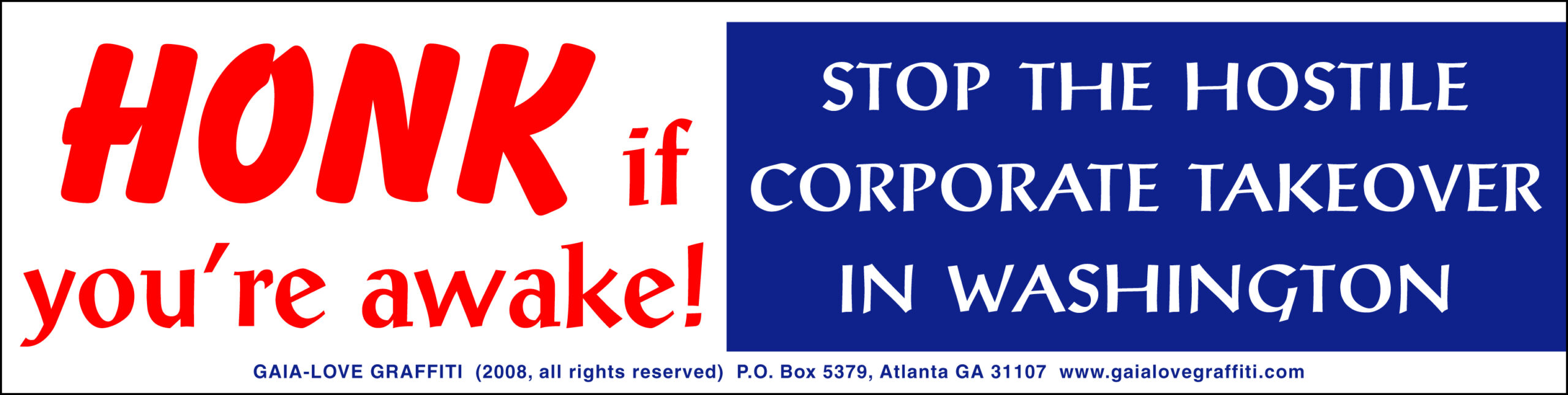
Still, the cycles of crisis in the human world periodically blast my political chakra wide open once more, and a “political poem” bursts out. My forthcoming book Honk If You’re Awake! collects four decades of such poems. Almost all were written before the ascendancy of Donald Trump. But Trump’s hostile takeover of American democracy merely ratchets the genocidal heritage of American empire up to a starkly visible new level. He is the reincarnation of every reactionary bully that ever stood in the way of American democracy’s evolution toward “a more perfect union,” a multicultural haven for “diversity, equity, and inclusion.”
These poems therefore illuminate the choice we face— and have always faced— now that we can at last no longer evade the necessity to choose. Is the United States of America a democracy, or is it an empire? Do we meekly turn around and go back to “Whites Only,” blacklists and loyalty oaths, back-yard fallout shelters and back-alley abortions? Or do we press on across this latest bridge toward Dr. King’s Beloved Community?
Evolution of a Political Poet
Regardless of its subject, every poem travels the same route to arrive on the page. As Carolyn Forché explains in the Introduction to her anthology Against Forgetting, “Like many other poets, I felt that I had no real choice regarding the impulse of my poems, and had only to wait, in meditative expectancy.”
My own method is less meditative than serendipitous. When I see something that stirs me deeply, a line or a phrase will sometimes flare briefly across my brain. If I capture it on paper— the only literary discipline I practice— it might become the seed of a new poem, or find a place in one already taking shape. Calling me “political” only accuses me of paying attention, not just to butterflies and sunsets but to gritty and painful realities as well.
My work varies widely in form, style, and technique, though I have never composed a song, competed in a slam, or attempted the emphatic rhythm and rhyme of hiphop. My teachers are the elder poets of my generation, especially Robert Bly and Galway Kinnell, who broke the cultural taboo in the 1960s to raise their voices against Jim Crow discrimination and the war against Vietnam.
But my development as a poet took a breathless leap forward when I discovered Spanish-speaking poets like César Vallejo, Juan Ramón Jiménez, Federico García Lorca, and Pablo Neruda. Even in translation, their work conveys the politically-charged atmospheres of their respective times and places in a language of hallucinatory brilliance, surreal metaphor and wrenching emotion. As a child of North American privilege, I do not pretend to share their experience, but their leaps of imagination have spurred my own attempts to new heights. Their concentrated intensity reveals much about the human reality behind abstractions like “oppression” and “imperialism.”
My sense of connection with the actual people at the receiving end of oppression and imperialism was jolted awake by two peace delegations I was invited to join. My visits to Nicaragua in 1989 and Colombia in 2003 were experiences too powerful to describe in any form but poetry. From each of these journeys I brought home notes which I pieced together into a chapbook-length poem, one of which I published in my first book. The second appears as the centerpiece of Honk If You’re Awake!
I have had the honor of performing my poems at political gatherings across the Southeast and beyond. These have included annual vigils at the now re-named “School of the Americas” at Georgia’s Fort Benning, protesting U.S. military intervention in Latin America, “One Billion Rising” in Atlanta, confronting violence against women around the world, and anti-nuclear rallies at Kings Bay submarine base in Georgia and the Oak Ridge weapons plant in Tennessee.
One of my most memorable readings took place in the downtown Atlanta park re-named “Troy Davis Park” during Occupy Atlanta, utilizing “the human microphone”— the crowd around me shouting back each line in a kind of call-and-response so the people in the back could hear.
Why the Powerful Fear Poetry
I have written poems prompted by abominations like the school shootings in Parkland, Florida, the taxpayer-funded bailout of the mega-banks, the fall of the Twin Towers and the invasion of Iraq. I have also written poems inspired by acts of resistance such as The Ribbon, a powerfully creative response to the prospect of nuclear annihilation, and the student uprising at Northwestern University to protest the school’s investments in South African apartheid.
Both of those inspirational events took place in 1985, over half my lifetime ago. But as Robert Bly notes in his Vietnam-era essay “Leaping Up Into Political Poetry,” events— whether inspiring or appalling— are the occasion, not the source of a poem. “The political activists in the literary world are wrong,” he insists. “They try to force political poetry out of poets by pushing them more deeply into events, making them feel guilt if they don’t abandon privacy. But the truth is that the political poem comes out of the deepest privacy.”
Political poems, in other words, tap the same wellsprings of inspiration and draw on the same reservoir of form and technique that all poems do. The poetry of compassion, prophecy, vision and witness does not spring from the times we live in, from revolutionary theories of capital and labor, analyses of neocolonialism or class war, but from what persists from generation to generation in the heart and conscience of the individual. Political poetry is the human in me, responding to the human in those caught up in today’s headlines, reaching out to the human in you.
Can poetry have a measurable impact on political reality? I don’t know— and if I did, it would have no measurable impact on my motives for writing. We live in a time when more than ever before, all of us are called to do what we can to defend the defenseless Earth and its innocents. But Spanish poet Federico García Lorca, Chilean songwriter Victor Jara and his North American counterpart Joe Hill, Nigerian poet Ken Saro-Wiwa and Palestinian poet Refaat Alareer might answer if they could. All died a martyr’s death because someone in power feared the power of poetry.
But to question the usefulness of politically-aware poetry is itself an academic exercise. Just use your imagination. Imagine how different the world might be if poets had played the kind of role in the U.S.A. that they have played in the humbler nations that have long been pawns of empire. If American poets had filled the literary journals with outraged compassion for the victims of lynchings and death squads, Sand Creek and Wounded Knee. If they had prophetically reminded America that what happens to nameless foreigners might also happen to us. If they had inspired their readers with the vision of a world founded on mutual respect, across all boundaries of race, class, gender and sexuality. If they had not been content just to write and publish, but had looked across those boundaries and built a bridge of imagery and metaphor in the words they chose.
As some in fact did, and still do. But not nearly enough.
Note: These are my personal opinions and do not represent any organization I’m involved in. If my words resonate for you, please share widely. You can subscribe (or unsubscribe) at StephenWing.com. Read previous installments of “Wingtips” here. Contains no AI ingredients.

0 Comments